
Upper limb muscles in 3D
Turn the muscles of the pectoral girdle and upper limb, tap one to read its textbook passage, see the groups the textbook states and follow a tour muscle by muscle.
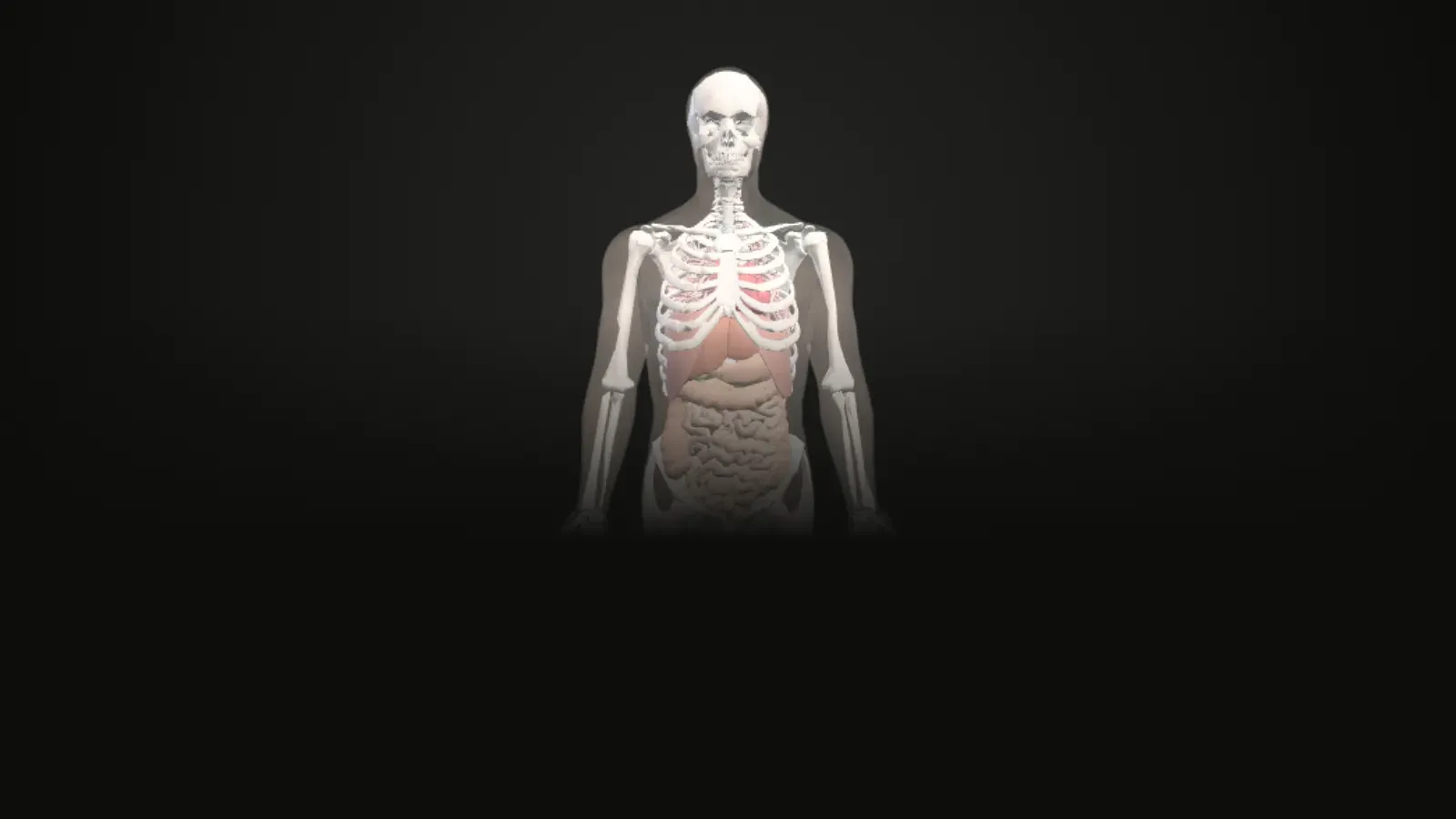
Interactive 3D atlas
Loads about 6 MB of 3D data the first time. Works best on a laptop or a recent phone.
Anatomy Atlas
Layers
Muscles are shown on the reference male body for now. No verified female muscle model yet.
Heart
Organ workstationColour parts by
Section cut
Elevation 0°
In the chest
Where everything in this atlas comes from
Study the upper limb muscles in 3D
Turn the muscles of the pectoral girdle and upper limb, tap one to read its textbook passage, see the groups the textbook states and follow a tour muscle by muscle.
Turn and zoom
Drag to rotate, scroll or pinch to zoom, and tap any muscle to see its name and its textbook passage.
Groups from the textbook
Show or hide the groups that the textbook states. The sentence that states each group is shown with it.
Peel
Hide a muscle to see what is behind it, or peel a group layer by layer where the textbook states the order.
Section cuts and explode
Cut through the muscles in transverse, coronal or sagittal planes, or pull them apart.
Guided tour
Follow the "Muscle by muscle" tour one step at a time, or press Play and let the camera fly to each step.
About the upper limb muscles
This page goes with the 3D viewer above: the upper limb muscles of the reference body, with 124 muscle meshes you can turn, tap and peel away. Below you will find the muscle groups that the textbook states, a table of origin, insertion and action for the 16 muscles that the textbook lists for section 11.5, and answers to common questions. Every origin, insertion and action is quoted word for word from OpenStax Anatomy and Physiology 2e, with a link to its section. Nerve supply is not in these textbook tables, so the atlas does not show it.
Muscle groups: upper limb muscles
These are the groups OpenStax states for this region, each with the sentence that states it.
- Rotator cuff(8 meshes)
Tendons of the infraspinatus, supraspinatus, teres minor, and the subscapularis form the rotator cuff, which forms a foundation on which the arms and shoulders can be stabilized and move.
OpenStax, Ch. 11 Critical Thinking Questions- Anterior compartment of the arm(8 meshes)
anterior compartment of the arm: (anterior flexor compartment of the arm) the biceps brachii, brachialis, brachioradialis, and their associated blood vessels and nerves
OpenStax, Ch. 11 Key Terms- Superficial anterior compartment of the forearm(12 meshes)
From lateral to medial, the superficial anterior compartment of the forearm includes the flexor carpi radialis, palmaris longus, flexor carpi ulnaris, and flexor digitorum superficialis.
OpenStax, 11.5 Muscles of the Pectoral Girdle and Upper Limbs- Deep anterior compartment of the forearm(4 meshes)
deep anterior compartment: flexor pollicis longus, flexor digitorum profundus, and their associated blood vessels and nerves
OpenStax, Ch. 11 Key Terms- Superficial posterior compartment of the forearm(12 meshes)
The extensor carpi radialis longus, extensor carpi radialis brevis, extensor digitorum, extensor digiti minimi, and extensor carpi ulnaris are the muscles found in the superficial posterior compartment.
OpenStax, Ch. 11 Chapter Review- Deep posterior compartment of the forearm(8 meshes)
deep posterior compartment of the forearm: (deep posterior extensor compartment of the forearm) the abductor pollicis longus, extensor pollicis brevis, extensor pollicis longus, extensor indicis, and their associated blood vessels and nerves
OpenStax, Ch. 11 Key Terms- Thenar muscles(10 meshes)
The thenar muscles include the abductor pollicis brevis, opponens pollicis, flexor pollicis brevis, and the adductor pollicis.
OpenStax, 11.5 Muscles of the Pectoral Girdle and Upper Limbs- Hypothenar muscles(6 meshes)
The hypothenar muscles include the abductor digiti minimi, flexor digiti minimi brevis, and the opponens digiti minimi.
OpenStax, 11.5 Muscles of the Pectoral Girdle and Upper Limbs- Intermediate muscles of the hand(6 meshes)
Finally, the intermediate muscles act on all the fingers and include the lumbrical, the palmar interossei, and the dorsal interossei.
OpenStax, 11.5 Muscles of the Pectoral Girdle and Upper Limbs
Origin, insertion and action of the upper limb muscles
Copied unchanged from the tables of OpenStax 11.5 Muscles of the Pectoral Girdle and Upper Limbs. The textbook's "Prime mover" column is shown as Muscle and its "Movement" column as Action. Only muscles that the textbook lists in these tables appear here; the 3D model has more.
| Position in the thorax | Muscle | Origin | Insertion | Action |
|---|---|---|---|---|
| Anterior thorax | Subclavius | First rib | Inferior surface of clavicle | Stabilizes clavicle during movement by depressing it |
| Anterior thorax | Pectoralis minor | Anterior surfaces of certain ribs (2–4 or 3–5) | Coracoid process of scapula | Rotates shoulder anteriorly (throwing motion); assists with inhalation |
| Anterior thorax | Serratus anterior | Muscle slips from certain ribs (1–8 or 1–9) | Anterior surface of vertebral border of scapula | Moves arm from side of body to front of body; assists with inhalation |
| Posterior thorax | Trapezius | Skull; vertebral column | Acromion and spine of scapula; clavicle | Elevates shoulders (shrugging); pulls shoulder blades together; tilts head backwards |
| Posterior thorax | Rhomboid major | Thoracic vertebrae (T2–T5) | Medial border of scapula | Stabilizes scapula during pectoral girdle movement |
| Posterior thorax | Rhomboid minor | Cervical and thoracic vertebrae (C7 and T1) | Medial border of scapula | Stabilizes scapula during pectoral girdle movement |
| Group | Muscle | Origin | Insertion | Action |
|---|---|---|---|---|
| Thenar muscles | Abductor pollicis brevis | Flexor retinaculum; and nearby carpals | Lateral base of proximal phalanx of thumb | Moves thumb away from body |
| Thenar muscles | Opponens pollicis | Flexor retinaculum; trapezium | Anterior of first metacarpal | Moves thumb across palm to touch other fingers |
| Thenar muscles | Flexor pollicis brevis | Flexor retinaculum; trapezium | Lateral base of proximal phalanx of thumb | Flexes thumb |
| Thenar muscles | Adductor pollicis | Capitate bone; bases of metacarpals 2–4; front of metacarpal 3 | Medial base of proximal phalanx of thumb | Moves thumb toward body |
| Hypothenar muscles | Abductor digiti minimi | Pisiform bone | Medial side of proximal phalanx of little finger | Moves little finger away from body |
| Hypothenar muscles | Flexor digiti minimi brevis | Hamate bone; flexor retinaculum | Medial side of proximal phalanx of little finger | Flexes little finger |
| Hypothenar muscles | Opponens digiti minimi | Hamate bone; flexor retinaculum | Medial side of fifth metacarpal | Moves little finger across palm to touch thumb |
| Intermediate muscles | Lumbricals | Palm (lateral sides of tendons in flexor digitorum profundus) | Fingers 2–5 (lateral edges of extensional expansions on first phalanges) | Flexes each finger at metacarpo-phalangeal joints; extends each finger at interphalangeal joints |
| Intermediate muscles | Palmar interossei | Side of each metacarpal that faces metacarpal 3 (absent from metacarpal 3) | Extensor expansion on first phalanx of each finger (except finger 3) on side facing finger 3 | Adducts and flexes each finger at metacarpo-phalangeal joints; extends each finger at interphalangeal joints |
| Intermediate muscles | Dorsal interossei | Sides of metacarpals | Both sides of finger 3; for each other finger, extensor expansion over first phalanx on side opposite finger 3 | Abducts and flexes the three middle fingers at metacarpo-phalangeal joints; extends the three middle fingers at interphalangeal joints |
Source: OpenStax, Anatomy and Physiology 2e, 11.5 Muscles of the Pectoral Girdle and Upper Limbs. CC BY-NC-SA 4.0. Nerve supply is not part of these tables.
Muscles in this model
124 muscle meshes, with left and right counted separately, for the textbook section OpenStax 11.5 Muscles of the Pectoral Girdle and Upper Limbs. The workstation downloads about 3.4 MB of muscle data the first time you open it.
- Rotator cuff8
- Anterior compartment of the arm8
- Superficial anterior compartment of the forearm12
- Deep anterior compartment of the forearm4
- Superficial posterior compartment of the forearm12
- Deep posterior compartment of the forearm8
- Thenar muscles10
- Hypothenar muscles6
- Intermediate muscles of the hand6
- Other muscles of this region (not grouped in the textbook)50
Muscles of the shoulder and upper limb can be divided into four groups: muscles that stabilize and position the pectoral girdle, muscles that move the arm, muscles that move the forearm, and muscles that move the wrists, hands, and fingers.
OpenStax, 11.5 Muscles of the Pectoral Girdle and Upper Limbs
Guided tour: Muscle by muscle (39 steps)
Each step highlights only the muscles that its sentence names. The sentence is quoted word for word from OpenStax Anatomy and Physiology 2e.
1. Subclavius, pectoralis minor, serratus anterior
The anterior muscles include the subclavius, pectoralis minor, and serratus anterior.
OpenStax, 11.5 Muscles of the Pectoral Girdle and Upper Limbs2. Trapezius, rhomboid major, rhomboid minor
The posterior muscles include the trapezius, rhomboid major, and rhomboid minor.
OpenStax, 11.5 Muscles of the Pectoral Girdle and Upper Limbs3. Pectoralis major
The two axial muscles are the pectoralis major and the latissimus dorsi.
OpenStax, 11.5 Muscles of the Pectoral Girdle and Upper Limbs4. Pectoralis major
The pectoralis major is thick and fan-shaped, covering much of the superior portion of the anterior thorax.
OpenStax, 11.5 Muscles of the Pectoral Girdle and Upper Limbs5. Deltoid
The deltoid, the thick muscle that creates the rounded lines of the shoulder is the major abductor of the arm, but it also facilitates flexing and medial rotation, as well as extension and lateral rotation.
OpenStax, 11.5 Muscles of the Pectoral Girdle and Upper Limbs6. Subscapularis
The subscapularis originates on the anterior scapula and medially rotates the arm.
OpenStax, 11.5 Muscles of the Pectoral Girdle and Upper Limbs7. Supraspinatus, infraspinatus
Named for their locations, the supraspinatus (superior to the spine of the scapula) and the infraspinatus (inferior to the spine of the scapula) abduct the arm, and laterally rotate the arm, respectively.
OpenStax, 11.5 Muscles of the Pectoral Girdle and Upper Limbs8. Teres major, teres minor
The thick and flat teres major is inferior to the teres minor and extends the arm, and assists in adduction and medial rotation of it.
OpenStax, 11.5 Muscles of the Pectoral Girdle and Upper Limbs9. Teres minor
The long teres minor laterally rotates and extends the arm.
OpenStax, 11.5 Muscles of the Pectoral Girdle and Upper Limbs10. Coracobrachialis
Finally, the coracobrachialis flexes and adducts the arm.
OpenStax, 11.5 Muscles of the Pectoral Girdle and Upper Limbs11. Subscapularis, supraspinatus, infraspinatus, teres minor
The tendons of the deep subscapularis, supraspinatus, infraspinatus, and teres minor connect the scapula to the humerus, forming the rotator cuff (musculotendinous cuff), the circle of tendons around the shoulder joint.
OpenStax, 11.5 Muscles of the Pectoral Girdle and Upper Limbs12. Biceps brachii, brachialis, brachioradialis
The forearm flexors include the biceps brachii, brachialis, and brachioradialis.
OpenStax, 11.5 Muscles of the Pectoral Girdle and Upper Limbs13. Triceps brachii, anconeus
The extensors are the triceps brachii and anconeus.
OpenStax, 11.5 Muscles of the Pectoral Girdle and Upper Limbs14. Pronator teres, pronator quadratus, supinator
The pronators are the pronator teres and the pronator quadratus, and the supinator is the only one that turns the forearm anteriorly.
OpenStax, 11.5 Muscles of the Pectoral Girdle and Upper Limbs15. Biceps brachii, brachialis, brachioradialis
The biceps brachii, brachialis, and brachioradialis flex the forearm.
OpenStax, 11.5 Muscles of the Pectoral Girdle and Upper Limbs16. Biceps brachii
The two-headed biceps brachii crosses the shoulder and elbow joints to flex the forearm, also taking part in supinating the forearm at the radioulnar joints and flexing the arm at the shoulder joint.
OpenStax, 11.5 Muscles of the Pectoral Girdle and Upper Limbs17. Biceps brachii, brachialis
Deep to the biceps brachii, the brachialis provides additional power in flexing the forearm.
OpenStax, 11.5 Muscles of the Pectoral Girdle and Upper Limbs18. Brachioradialis
Finally, the brachioradialis can flex the forearm quickly or help lift a load slowly.
OpenStax, 11.5 Muscles of the Pectoral Girdle and Upper Limbs19. Flexor carpi radialis, palmaris longus, flexor carpi ulnaris, flexor digitorum superficialis
From lateral to medial, the superficial anterior compartment of the forearm includes the flexor carpi radialis, palmaris longus, flexor carpi ulnaris, and flexor digitorum superficialis.
OpenStax, 11.5 Muscles of the Pectoral Girdle and Upper Limbs20. Flexor pollicis longus, flexor digitorum profundus
These are the flexor pollicis longus and the flexor digitorum profundus.
OpenStax, 11.5 Muscles of the Pectoral Girdle and Upper Limbs21. Extensor carpi radialis brevis, extensor digitorum, extensor digiti minimi, extensor carpi ulnaris
These are the extensor radialis longus, extensor carpi radialis brevis, extensor digitorum, extensor digiti minimi, and the extensor carpi ulnaris.
OpenStax, 11.5 Muscles of the Pectoral Girdle and Upper Limbs22. Abductor pollicis brevis, opponens pollicis, flexor pollicis brevis, adductor pollicis
The thenar muscles include the abductor pollicis brevis, opponens pollicis, flexor pollicis brevis, and the adductor pollicis.
OpenStax, 11.5 Muscles of the Pectoral Girdle and Upper Limbs23. Abductor digiti minimi, flexor digiti minimi brevis, opponens digiti minimi
The hypothenar muscles include the abductor digiti minimi, flexor digiti minimi brevis, and the opponens digiti minimi.
OpenStax, 11.5 Muscles of the Pectoral Girdle and Upper Limbs24. Lumbrical, palmar interossei, dorsal interossei
Finally, the intermediate muscles act on all the fingers and include the lumbrical, the palmar interossei, and the dorsal interossei.
OpenStax, 11.5 Muscles of the Pectoral Girdle and Upper Limbs25. Subclavius, pectoralis minor, serratus anterior
The anterior thoracic muscles are the subclavius, pectoralis minor, and the serratus anterior.
OpenStax, Ch. 11 Chapter Review26. Trapezius, levator scapulae, rhomboid major, rhomboid minor
The posterior thoracic muscles are the trapezius, levator scapulae, rhomboid major, and rhomboid minor.
OpenStax, Ch. 11 Chapter Review27. Pectoralis major
The ones that originate on the axial skeleton are the pectoralis major and the latissimus dorsi.
OpenStax, Ch. 11 Chapter Review28. Deltoid, subscapularis, supraspinatus, infraspinatus, teres major, teres minor, coracobrachialis
The deltoid, subscapularis, supraspinatus, infraspinatus, teres major, teres minor, and coracobrachialis originate on the scapula.
OpenStax, Ch. 11 Chapter Review29. Biceps brachii, brachialis, brachioradialis
The forearm flexors include the biceps brachii, brachialis, and brachioradialis.
OpenStax, Ch. 11 Chapter Review30. Triceps brachii, anconeus
The extensors are the triceps brachii and anconeus.
OpenStax, Ch. 11 Chapter Review31. Pronator teres, pronator quadratus
The pronators are the pronator teres and the pronator quadratus.
OpenStax, Ch. 11 Chapter Review32. Supinator
The supinator is the only one that turns the forearm anteriorly.
OpenStax, Ch. 11 Chapter Review33. Flexor carpi radialis, palmaris longus, flexor carpi ulnaris, flexor digitorum superficialis
These muscles are the flexor carpi radialis, palmaris longus, flexor carpi ulnaris, and the flexor digitorum superficialis.
OpenStax, Ch. 11 Chapter Review34. Flexor pollicis longus, flexor digitorum profundus
These are the flexor pollicis longus and the flexor digitorum profundus.
OpenStax, Ch. 11 Chapter Review35. Extensor carpi radialis longus, extensor carpi radialis brevis, extensor digitorum, extensor digiti minimi, extensor carpi ulnaris
The extensor carpi radialis longus, extensor carpi radialis brevis, extensor digitorum, extensor digiti minimi, and extensor carpi ulnaris are the muscles found in the superficial posterior compartment.
OpenStax, Ch. 11 Chapter Review36. Extensor pollicis brevis, extensor pollicis longus, extensor indicis
The deep posterior compartment includes the abductor longus, extensor pollicis brevis, extensor pollicis longus, and the extensor indicis.
OpenStax, Ch. 11 Chapter Review37. Abductor pollicis brevis, opponens pollicis, flexor pollicis brevis, adductor pollicis
The thenar muscles, which are located on the lateral part of the palm, are the abductor pollicis brevis, opponens pollicis, flexor pollicis brevis, and adductor pollicis.
OpenStax, Ch. 11 Chapter Review38. Abductor digiti minimi, flexor digiti minimi brevis, opponens digiti minimi
The hypothenar muscles, which are located on the medial part of the palm, are the abductor digiti minimi, flexor digiti minimi brevis, and opponens digiti minimi.
OpenStax, Ch. 11 Chapter Review39. Lumbrical, palmar interossei, dorsal interossei
The intermediate muscles, located in the middle of the palm, are the lumbricals, palmar interossei, and dorsal interossei.
OpenStax, Ch. 11 Chapter Review
What this model does not show
The textbook names 1 muscles in this section that this 3D model has no mesh for: latissimus dorsi. Muscles are shown on the reference male body for now. No verified female muscle model yet.
Where the data or the textbook has a gap, the atlas says so instead of filling it in.
Keep exploring
You moved to another screen of the atlas. Read the study notes for it on its own page: the atlas.
Questions
What are the origin and insertion of a muscle?
OpenStax Anatomy and Physiology 2e says: "The end of the muscle that attaches to the bone being pulled is called the muscle’s insertion and the end of the muscle attached to a fixed, or stabilized, bone is called the origin."
Where do the origin, insertion and action in the upper limb muscles table come from?
They are copied unchanged from the 2 tables in OpenStax Anatomy and Physiology 2e, section 11.5 (Muscles of the Pectoral Girdle and Upper Limbs). The textbook's "Prime mover" column is shown as Muscle and its "Movement" column as Action. The table lists 16 muscles: Subclavius, Pectoralis minor, Serratus anterior, Trapezius, Rhomboid major, Rhomboid minor, Abductor pollicis brevis, Opponens pollicis, Flexor pollicis brevis, Adductor pollicis, Abductor digiti minimi, Flexor digiti minimi brevis, Opponens digiti minimi, Lumbricals, Palmar interossei, Dorsal interossei.
Does the atlas show the nerve supply of the upper limb muscles?
No. The textbook text the atlas quotes does not give nerve supply in its muscle tables, and the atlas does not add anything that the textbook does not say.
What can I see in the upper limb muscles model?
The model has 124 muscle meshes, with left and right counted separately. 74 of them are in 9 groups that the textbook states: Rotator cuff, Anterior compartment of the arm, Superficial anterior compartment of the forearm, Deep anterior compartment of the forearm, Superficial posterior compartment of the forearm, Deep posterior compartment of the forearm, Thenar muscles, Hypothenar muscles, Intermediate muscles of the hand. 50 are not grouped in the textbook.
What is the "Muscle by muscle" tour?
It is a guided tour of 39 steps. Each step shows a sentence quoted from OpenStax Anatomy and Physiology 2e, section 11.5, and highlights only the muscles that the sentence names. Press Play to let the camera fly to each step for you.
Can I peel muscles away?
Yes. "Peel this muscle" hides the selected muscle so you can see what is behind it, and says nothing about how deep it lies. "Peel next layer" works for the 3 groups of this region whose layer order the textbook states in words.
How much does this workstation download?
About 3.4 MB of muscle data, the first time you open it. The muscle shapes are simplified so that every point stays within 1 mm of the original surface.
Is there a female muscle model?
Muscles are shown on the reference male body for now. No verified female muscle model yet.
What is missing from the upper limb muscles model?
The textbook names 1 muscles in this section that this 3D model has no mesh for: latissimus dorsi. Muscles are shown on the reference male body for now. No verified female muscle model yet.
Where does the information come from?
The 3D shapes come from the BodyParts3D dataset (and, for the female pelvic region, the Human Reference Atlas). Every explanation is a sentence quoted word for word from the open textbook OpenStax Anatomy and Physiology 2e, with a link to its section.
Can I use it to diagnose or treat anything?
No. The atlas is for learning only.
Credits and disclaimer
For learning only, not for diagnosis or treatment.
BodyParts3D, © The Database Center for Life Science licensed under CC Attribution 4.0 International. Text quoted from OpenStax, Anatomy and Physiology 2e, © Rice University, CC BY-NC-SA 4.0. Female pelvic region from the Human Reference Atlas (HuBMAP), CC BY 4.0.
This tool is free, non-commercial and made for education. It has no ads and no paid features.