
Muscles of the human body in 3D
See the muscles of a whole reference body, tap any muscle to read what the textbook says about it, and peel muscles away to see what is behind them. Free, in your browser.
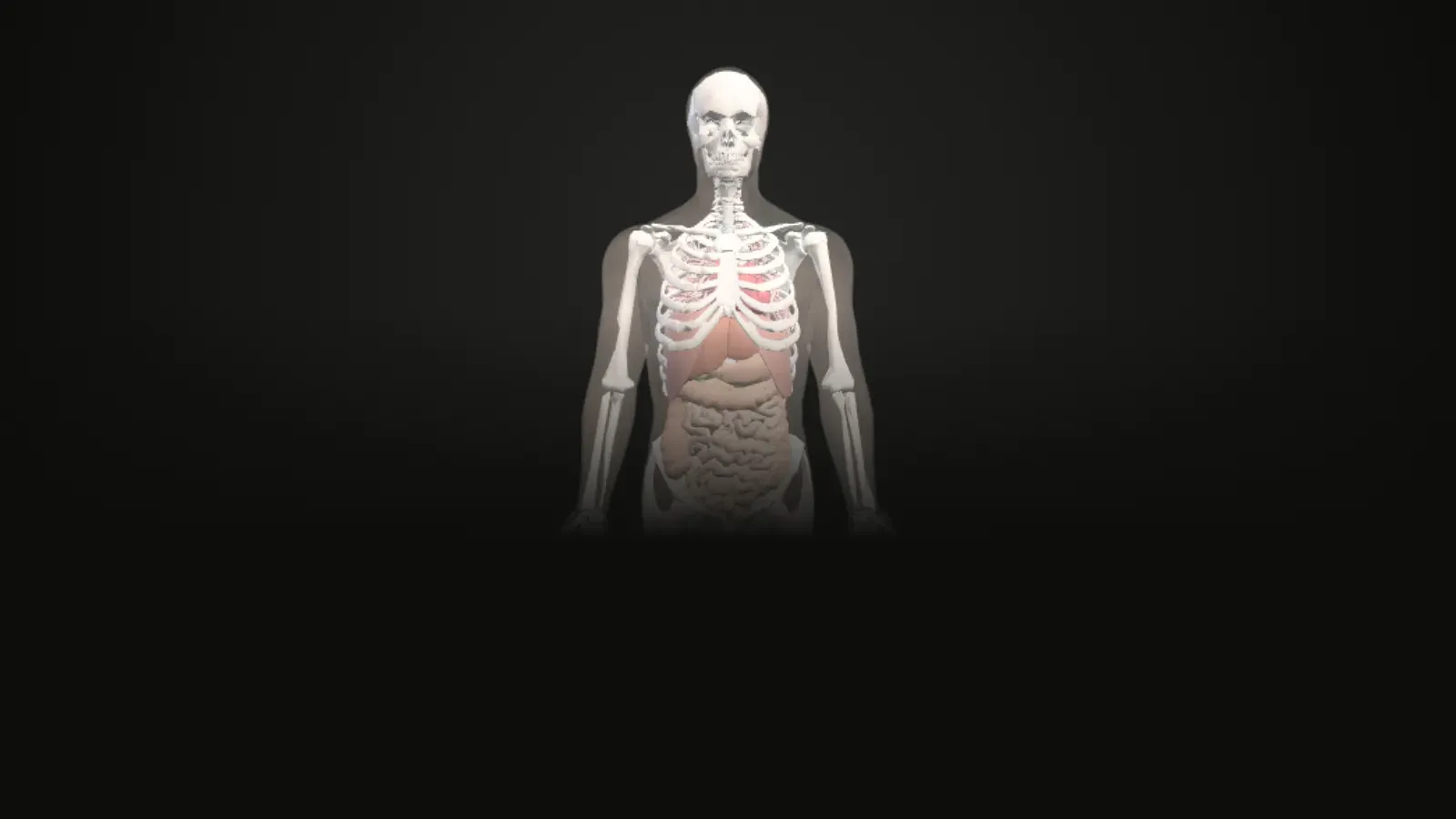
Interactive 3D atlas
Loads about 7 MB of 3D data the first time. Works best on a laptop or a recent phone.
Anatomy Atlas
Layers
Muscles are shown on the reference male body for now. No verified female muscle model yet.
Heart
Organ workstationColour parts by
Section cut
Elevation 0°
In the chest
Where everything in this atlas comes from
Study the muscles in 3D
See the muscles of a whole reference body, tap any muscle to read what the textbook says about it, and peel muscles away to see what is behind them. Free, in your browser.
Turn and zoom
Drag to rotate, scroll or pinch to zoom, and use Front, Side and Back to snap the view.
Tap a muscle
Tap a muscle, or find it by name, to see its name, its region and the textbook passage that names it.
Peel a muscle
Hide the selected muscle to see what is behind it. Undo and Reset bring muscles back.
Peel next layer
Where the textbook states a layer order in words, peel that group one layer at a time and read the sentence the order comes from.
Open a workstation
Study the muscles of one region at better detail, with the groups the textbook states and a guided tour.
Muscles in this model
379 muscle meshes of the reference body are shown, with left and right counted separately. Muscles mode downloads about 5.3 MB of muscle data the first time you open it.
- Head, neck and back118
- Abdominal wall and thorax16
- Pectoral girdle and upper limb124
- Pelvic girdle and lower limb94
- Not covered by the textbook's four regions27
Muscle workstations
What this model does not show
The textbook names 23 muscles in its sections on these regions that this 3D model has no mesh for: Head, neck and back: buccinator, corrugator supercilii, frontalis, lateral pterygoid, masseter, medial pterygoid, multifidus, occipitalis, occipitofrontalis, orbicularis oculi, orbicularis oris, palatoglossus, styloglossus, temporalis. Abdominal wall and thorax: compressor urethrae, deep transverse perineal, internal oblique, quadratus lumborum, rectus abdominis, sphincter urethrovaginalis, transversus abdominis. Pectoral girdle and upper limb: latissimus dorsi. Pelvic girdle and lower limb: extensor digitorum brevis. Muscles are shown on the reference male body for now. No verified female muscle model yet.
Where the data or the textbook has a gap, the atlas says so instead of filling it in.
Keep exploring
You moved to another screen of the atlas. Read the study notes for it on its own page: the atlas.
Questions
How many muscles does the 3D model show?
379 muscle meshes of the BodyParts3D reference body, with left and right counted separately: 118 in head, neck and back, 16 in abdominal wall and thorax, 124 in pectoral girdle and upper limb, 94 in pelvic girdle and lower limb, and 27 that the textbook's four regions do not cover.
What does "Peel" do?
"Peel this muscle" hides the muscle you selected so you can see what is behind it; Undo and Reset bring muscles back. It says nothing about how deep a muscle lies. "Peel next layer" exists only for the 9 groups of muscles whose order the textbook states in words.
How much does Muscles mode download?
About 5.3 MB of muscle data, the first time you open Muscles mode. It is not downloaded until then. The muscle shapes are simplified so that every point stays within 3 mm of the original surface.
Is there a female muscle model?
Muscles are shown on the reference male body for now. No verified female muscle model yet.
What is missing from the muscles model?
The textbook names 23 muscles in its sections on these regions that this 3D model has no mesh for: Head, neck and back: buccinator, corrugator supercilii, frontalis, lateral pterygoid, masseter, medial pterygoid, multifidus, occipitalis, occipitofrontalis, orbicularis oculi, orbicularis oris, palatoglossus, styloglossus, temporalis. Abdominal wall and thorax: compressor urethrae, deep transverse perineal, internal oblique, quadratus lumborum, rectus abdominis, sphincter urethrovaginalis, transversus abdominis. Pectoral girdle and upper limb: latissimus dorsi. Pelvic girdle and lower limb: extensor digitorum brevis. Muscles are shown on the reference male body for now. No verified female muscle model yet.
Where does the information come from?
The 3D shapes come from the BodyParts3D dataset (and, for the female pelvic region, the Human Reference Atlas). Every explanation is a sentence quoted word for word from the open textbook OpenStax Anatomy and Physiology 2e, with a link to its section.
Can I use it to diagnose or treat anything?
No. The atlas is for learning only.
Credits and disclaimer
For learning only, not for diagnosis or treatment.
BodyParts3D, © The Database Center for Life Science licensed under CC Attribution 4.0 International. Text quoted from OpenStax, Anatomy and Physiology 2e, © Rice University, CC BY-NC-SA 4.0. Female pelvic region from the Human Reference Atlas (HuBMAP), CC BY 4.0.
This tool is free, non-commercial and made for education. It has no ads and no paid features.