
Upper limb bones in 3D
BetaExplore the bones of both arms, from the clavicle and scapula to the bones of the wrist and fingers, grouped under the textbook headings.
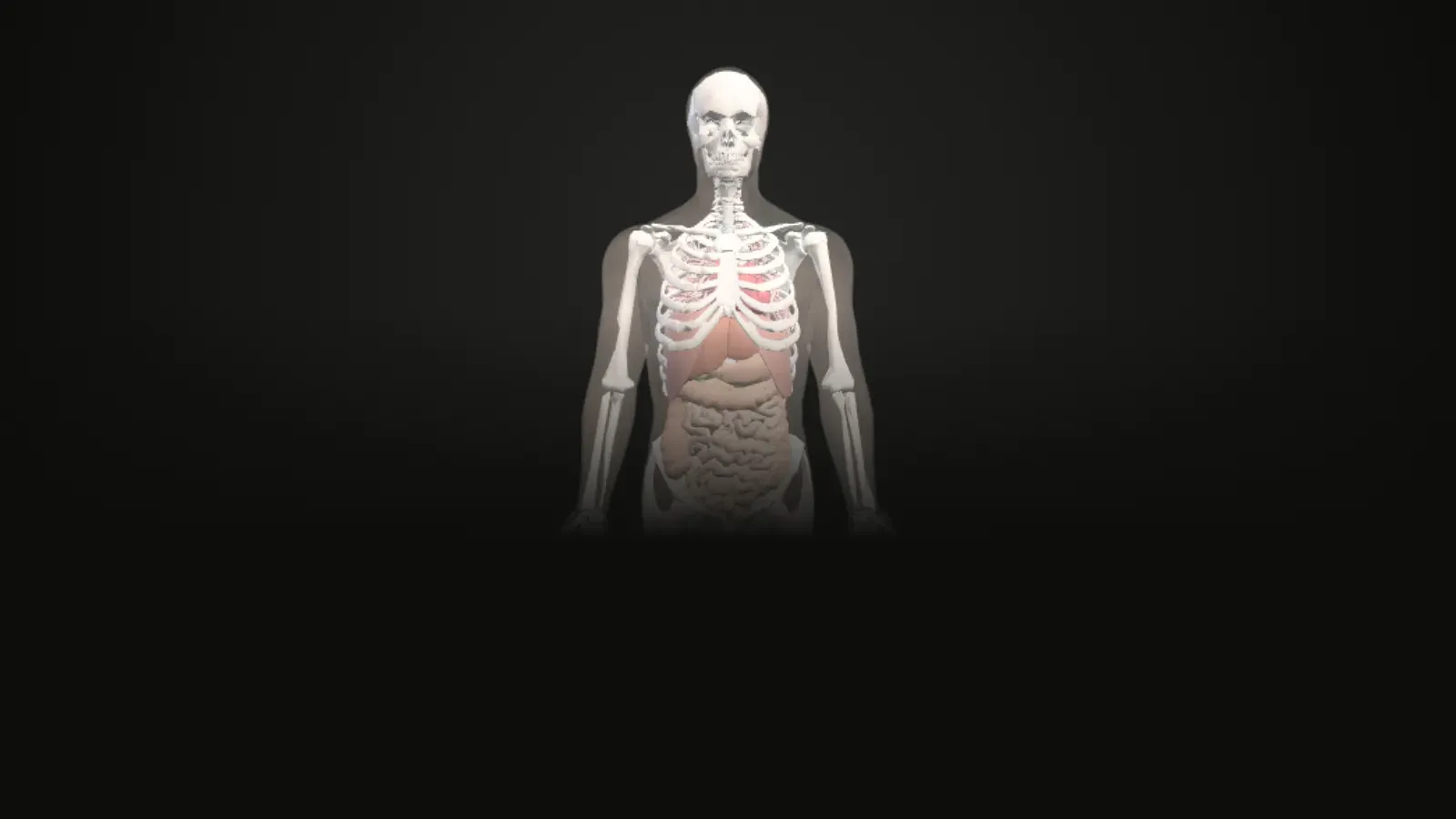
Interactive 3D atlas
Loads about 9 MB of 3D data the first time. Works best on a laptop or a recent phone.
Anatomy Atlas
Layers
Heart
Organ workstationColour parts by
Section cut
Elevation 0°
In the chest
Where everything in this atlas comes from
Study the upper limbs in 3D
Explore the bones of both arms, from the clavicle and scapula to the bones of the wrist and fingers, grouped under the textbook headings.
Turn and zoom
Drag to rotate, scroll or pinch to zoom, and tap any part to see its name and explanation.
Labels and standard views
Switch labels on or off and jump to front, back, side, top and bottom views, with an orientation cube.
Section cuts
Cut through the structure in transverse, coronal or sagittal planes and slide the cut through it.
Explode and see-through
Pull the parts apart, or make the outer layers faint to see what is inside.
Guided tour
Follow the "Bone by bone" tour one step at a time, or press Play and let the camera fly to each part.
Parts in this model
64 named parts, each with the FMA identifier the dataset gives it. Tap a group in the app to show or hide it.
- Clavicle2
- Scapula2
- Humerus2
- Ulna2
- Radius2
- Carpal Bones16
- Metacarpal Bones10
- Phalanx Bones28
Guided tour: Bone by bone (8 steps)
Each step highlights the parts it talks about. The sentence is quoted word for word from OpenStax Anatomy and Physiology 2e.
1. Clavicle
The clavicle has several important functions.
OpenStax, 8.1 Clavicle2. Scapula
The scapula is also part of the pectoral girdle and thus plays an important role in anchoring the upper limb to the body.
OpenStax, 8.1 Scapula3. Humerus
At its proximal end is the head of the humerus.
OpenStax, 8.2 Humerus4. Ulna
The ulna is the medial bone of the forearm.
OpenStax, 8.2 Ulna5. Radius
The head of the radius is a disc-shaped structure that forms the proximal end.
OpenStax, 8.2 Radius6. Carpal Bones
The carpal bones are arranged in two rows, forming a proximal row of four carpal bones and a distal row of four carpal bones.
OpenStax, 8.2 Carpal Bones7. Metacarpal Bones
The palm of the hand contains five elongated metacarpal bones.
OpenStax, 8.2 Metacarpal Bones8. Phalanx Bones
The fingers and thumb contain 14 bones, each of which is called a phalanx bone (plural = phalanges), named after the ancient Greek phalanx (a rectangular block of soldiers).
OpenStax, 8.2 Phalanx Bones
What this model does not show
The dataset names the triquetral bone where the textbook says triquetrum; the page shows both names.
Where the data or the textbook has a gap, the atlas says so instead of filling it in.
Keep exploring
You moved to another screen of the atlas. Read the study notes for it on its own page: the atlas.
Questions
What can I see in the upper limbs model?
The model has 64 named parts in 8 groups: Clavicle, Scapula, Humerus, Ulna, Radius, Carpal Bones, Metacarpal Bones, Phalanx Bones.
What is the "Bone by bone" tour?
It is a guided tour of 8 steps. Each step highlights the parts it describes and shows a sentence quoted from OpenStax Anatomy and Physiology 2e. Press Play to let the camera fly to each step for you.
What is missing from the upper limbs model?
The dataset names the triquetral bone where the textbook says triquetrum; the page shows both names.
Where does the information come from?
The 3D shapes come from the BodyParts3D dataset (and, for the female pelvic region, the Human Reference Atlas). Every explanation is a sentence quoted word for word from the open textbook OpenStax Anatomy and Physiology 2e, with a link to its section.
Can I use it to diagnose or treat anything?
No. The atlas is for learning only. It is a beta version and has not yet been reviewed by an anatomy educator.
Credits and disclaimer
For learning only, not for diagnosis or treatment. This is a beta version and it has not yet been reviewed by an anatomy educator.
BodyParts3D, © The Database Center for Life Science licensed under CC Attribution 4.0 International. Text quoted from OpenStax, Anatomy and Physiology 2e, © Rice University, CC BY-NC-SA 4.0. Female pelvic region from the Human Reference Atlas (HuBMAP), CC BY 4.0.
This tool is free, non-commercial and made for education. It has no ads and no paid features.