
Games Like Wordle: Word Puzzles to Play After Your Daily Guess
You solved today’s Wordle in four tries, felt good about it, and then it was over. One puzzle a day is part of the charm, but it also leaves a gap. If you are looking for games like Wordle to fill that gap, the good news is that “word game” covers a lot of ground, and some of it feels very different from guessing five letters.
This guide sorts word games into a few types, explains what each one is good at, and helps you pick the one that fits the way you like to think.
What makes Wordle so addictive
Before looking for something similar, it helps to know what you are actually after. Wordle works because of a few simple things:
- A tiny, clear goal. Find one hidden word.
- Instant feedback. Every guess tells you something, so you always feel you are getting closer.
- A short session. A few minutes, then you are done.
- A daily habit. Everyone is solving the same puzzle, so there is something to talk about.
Different games keep different parts of that recipe. Knowing which part you love most makes the search much easier.
Type 1: Guessing games
These are the closest relatives. You enter guesses, the game marks what is right or wrong, and you narrow it down. They suit people who love logic and elimination. The limit is the same as Wordle’s: when the puzzle is solved, the game is over for the day.
Type 2: Grouping and sorting games
Here you are shown a grid of words and must work out how they connect. The pleasure is spotting a pattern, and the frustration is a word that fits two groups. These reward a wide vocabulary and lateral thinking more than spelling.
Type 3: Word search games
You are given a grid of letters and trace the words hidden in it. This is the oldest style on the list, and it is relaxing in a way guessing games are not. There is no wrong answer to lose a streak over. You just look, spot a word and trace it.
Modern versions go further than the paper puzzle. Letters can connect diagonally, words can bend around the board, and a theme can tell you what to look for. That last idea is the one that makes word search feel fresh again.
Type 4: Anagram and swipe games
You get a handful of letters and build as many words as you can. These are fast and good for filling a few spare minutes, and they reward a quick eye over careful reasoning.
Type 5: Crosswords and mini crosswords
Clues and a grid. Slower, more knowledge-based, and very satisfying when a tricky crossing finally falls into place. They suit people who enjoy trivia and wordplay.
Where Word Match fits
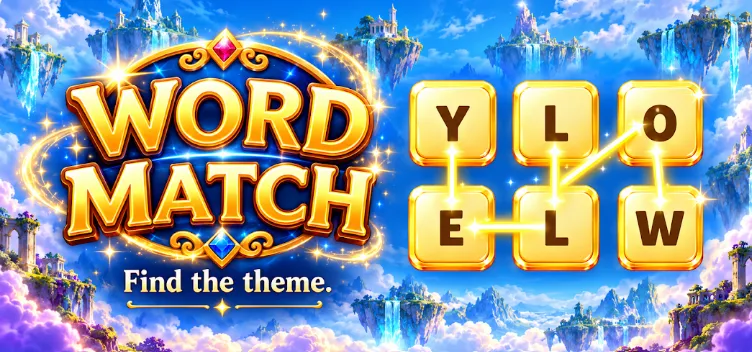
If what you liked about Wordle was the “aha” of finding a hidden word, but you wish you could keep playing, Word Match sits in the word search family with a twist borrowed from themed puzzles.
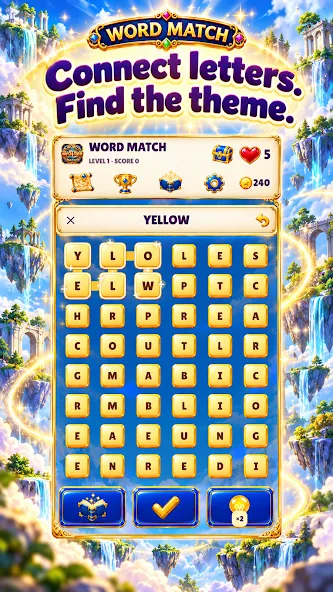
Every board starts with a clue, for example “Color palette”. You then connect neighboring letters, horizontally, vertically or diagonally, to find words that belong to that theme. Because you know the topic, you are not hunting blindly. You are thinking, “what words go with this?” and then looking for them.
The special word
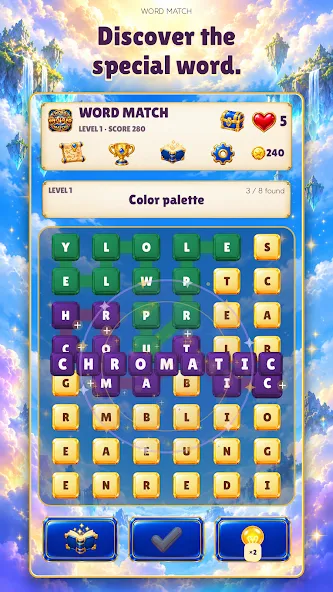
Each board also hides one special word that describes the theme and spans the whole board. Finding it is the best moment in the game, and the board reacts with a small celebration. It is the closest thing to the feeling of cracking a Wordle, except it appears in the middle of a puzzle instead of at the end.
No clock, no lost streak
Many word games add pressure: a timer, a limited number of tries, a streak to protect. Word Match has no countdown. You can put the phone down mid-puzzle and come back later, and missing a day does not wipe your progress on the daily reward trail. If your Wordle streak makes you anxious, this is a calmer way to play.
Plenty to play
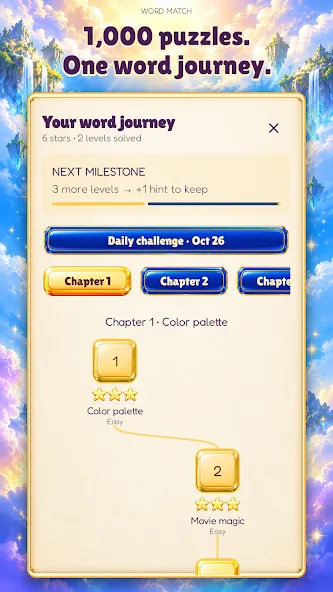
Wordle gives you one puzzle a day. Word Match gives you 1,000 levels to work through, starting with friendly themes like Color palette and Movie magic and moving toward harder subjects such as sports, films, music, food, nature, history and science. There is also a daily challenge for the days you want a set puzzle, in the Wordle spirit.
How to choose
A quick way to decide:
- You love logic and elimination: pick a guessing game.
- You love spotting patterns between words: try a grouping game.
- You want to relax and keep playing: a themed word search such as Word Match is a good match.
- You want fast bursts: an anagram or swipe game.
- You enjoy trivia and clues: a crossword.
You do not have to choose only one. Many people keep a daily guessing game for the morning and a calmer word search for the evening.
A few tips for word search games
If you are new to themed word searches, these habits help:
- Read the clue first. Think of five related words before you look at the board. You will spot them faster.
- Look for unusual letters. A Q, Z or X anchors a word and gives you a starting point.
- Try diagonals. Many beginners only scan across and down, and miss half the words.
- Collect bonus words. In Word Match, extra words you find that are not part of the theme build toward a hint, so they are never wasted.
- Do not rush. There is no timer, so let your eyes wander. The word you want often appears when you stop forcing it.
Frequently asked questions
What is a good word game if I like Wordle?
It depends on what you enjoy. If you like guessing and logic, choose another guessing game. If you like finding words and want to keep playing, a themed word search such as Word Match gives you many puzzles instead of one per day.
Are there word games with no timer?
Yes. Word Match has no countdown, so you can play at your own pace. The core puzzles also work offline, although rewarded videos and Google Play purchases need an internet connection.
Are word games good for your brain?
They exercise vocabulary, pattern recognition and memory, and many people find them a pleasant way to wind down. They are a fun habit rather than a medical treatment.
Is Word Match free?
Yes. It is free to play on Android, with ads and optional in-app purchases for hearts and hints. It is designed for players aged 13 and above.
Ready to try one?
If a themed word search sounds like your kind of puzzle, Word Match is on Google Play. Start with Chapter 1, follow the clue, and see how long it takes you to find the special word.
